

KYB for Marketplaces: Stopping Fake Sellers, Fraudulent Businesses, and Synthetic Vendors


Everyday new online marketplaces are being introduced, and in 2024 alone these platforms generated more than $3.8 trillion in global merchandise value. Moreover, customers are also adopting such platforms and usage is growing at a sustainable 10% every year. While it improves business opportunities it also introduces new risks around online transactions, fake businesses, and faulty sellers.

Having a strong KYB process for marketplaces is one of the best ways to combat fake sellers and fraudulent businesses. Therefore, leveraging platforms like ChainIT that provides robust yet secure verification for global businesses through immutable business record databases, identity risk scoring, and AML-aligned KYB compliance that assist in stopping fraud on your marketplace platform and promote a safer business environment.
Understanding KYB for Marketplaces
Effective KYB Verification practices help marketplaces validate business entities, reduce financial crime risk, and maintain regulatory alignment across high-volume, multi-party platform ecosystems.
What is KYB (Know Your Business)?
Know Your Business is a process that helps to verify the legality of a business through ownership records, documents, and other business credentials and this makes preventing financial crime and fraud more easier.
While many people think KYC and KYB are similar, they are often different, as KYC is more focused on verifying individuals on a platform, and KYB is used to verify businesses that want to sell on a marketplace platform.
Why Marketplaces Need KYB?
KYB is a process that should not be underestimated when building a marketplace, so here are some reasons why your platform needs it.
- Reduce fraudulent sellers & synthetic vendors.
By leveraging the KYB process, you can identify fraudulent sellers and vendors that are building their business on illegal documents and restrict them from your platform. This will reduce such fraud risks for your business platform.
- Prevent regulatory and financial risks.
KYB Business Verification includes checking for anti-money laundering laws and complying with global regulations with regard to business information. This helps in preventing regulatory and financial risks involved in working with unverified businesses.
- Enhance onboarding compliance
With a structured KYB process, you can improve your business’s compliance standing by getting the details during onboarding and then using them to evaluate a business for your platform’s needs.
The Risks of Not Implementing KYB in Marketplaces
If you are a marketplace business that does not have a proper KYB for marketplace and compliance processes set up, you are taking a big risk. Regulatory bodies and enforcement agencies oversee financial crime, payments, and consumer protection when it comes to non-compliant business, and in 2024 alone, they have ordered fines worth $8.2 billion.
On the other hand, being compliant and using the right KYB platform does not cost as much. But if you are not sure about implementing KYB for the marketplace, let’s look at some more risks of not implementing KYB for your marketplace.
Fake Sellers & Synthetic Vendors
- Fake sellers are increasing at a rapid pace, and they create fake business listings and documents to onboard on marketplaces and then cheat users. These fake sellers may accept orders from your customers on the marketplace, but never deliver anything and just run away with the money.
- Fraudsters can use product photos and descriptions from other sellers on the platform, use dark patterns to win customer confidence, and pressure them into making payments off the marketplace platform.
- Such fraud is prevalent with marketplaces, and it not only causes monetary losses but also damages your marketplace’s reputation and negatively affects your growth trajectory.
Also Read: How 7000 Ghosts Stole $200 Million?
Financial & Reputational Losses
- When you don’t add the KYB process to your marketplace, you are directly exposing yourself to financial and reputational losses from fake sellers and businesses. It can harm your brand value and damage user confidence, which is hard to rebuild.
- Fraudulent sellers will accept payments on your marketplace platform and disappear with the funds, leading to chargebacks and penalties on the payment processing side. With higher chargeback penalties and ratios, payment processors may add additional fees to offer you services, and this will result in other financial issues for your business.
- If fraud happens on your marketplace, customers will never think of associating it with a specific seller, but your marketplace will be held responsible, and you will lose customer credibility. As customers stop using your marketplace, investors will lose confidence, and you will find it harder to grow the business or even take on additional debt to fuel growth, due to fraudulent activities and fewer customers.
Did you Know?
Every year, an average eCommerce marketplace loses around $10.2 million to online fraud, with 79% of eCommerce businesses reporting a rise in fraudulent transactions. This statistic shows how businesses suffer due to fake sellers and vendors.
Compliance & Regulatory Risks
- A KYB for marketplace process is designed to protect you from compliance and regulatory risks across the globe, but if you miss adding it to your business, you are violating financial crime regulations.
- By missing the KYB process, you may allow unverified businesses to operate on your platform, and this can lead to KYC AML Compliance violations if illegal funds flow through your marketplace.
- If you are caught in any such regulatory issues, you can face significant penalties for not complying with laws, and your business license can also be suspended if the fraudulent operations are significant in nature.
Operational Inefficiencies & Onboarding Delays
- Without a clear marketplace KYB onboarding process, you add delays and errors into your onboarding workflow, and scaling beyond a certain becomes an issue. Manual document verification can lead to human errors and increase processing time for new vendor onboarding.
- As your platform grows, you cannot scale the manual process beyond a threshold safely, and it will either delay onboarding or make the process risky through unclear checks, and introduce compliance risks.
Increased Platform Vulnerability to Fraud
- If you don’t have a strict KYB process for marketplaces, your business marketplace becomes an easy target for fake sellers and fraudulent businesses. They will repeatedly sign up with new accounts and exploit customers on your platforms.
- To look like established sellers, they will inflate their reviews, post misleading claims and carry out fraud on your marketplace platform.
- As you don’t have much detail about such actors on the platform without KYB, it becomes hard to trace ownership and prosecute such fake businesses and sellers when they hit your marketplace.
Streamlined KYB Process for Marketplaces’ Security

Modern KYB is not a one-time process, rather, it is a proactive process that helps the business at every step and ensures a secure business environment for everyone involved in the process.
Step 1 – Business Identity Verification
The first step of any KYB process starts with verifying business identity using official documents, ensuring authenticity, reducing fraud risk, and enabling marketplaces to onboard reliable global sellers.
Key focus areas include:
- Risk Mitigation Focus
- Regulatory Compliance Checks
- Cross-Border Document Validation
- Authenticity Assurance
At the end of this step, you can make a high-confidence determination whether a business seller is a real, legally registered, and approved business with traceable details or not. To make things easier, you can leverage ChainIT ORG to create seller identities that are tamper-proof and trace and verify them through various integrations on the platform.
Step 2 – Risk Assessment & Screening
After verifying legitimacy, assign a risk score to businesses using global watchlists, past behavior, and operational patterns to ensure safe marketplace participation.
Crucial risk evaluation areas:
- Transaction Pattern Insights
- Behavioral Risk Indicators
- Sanctions & Watchlist Checks
- Access Control Measures
These measures help marketplaces proactively mitigate fraud, monitor high-risk activities, and tailor feature access based on each business’s risk profile.
Step 3 – Continuous Monitoring & Re-Verification
KYB is an ongoing process requiring continuous monitoring and periodic re-verification to ensure business data accuracy and regulatory compliance.
Effective monitoring focus areas:
- Transaction & Listing Alerts
- Buyer Complaint Tracking
- Periodic KYB Reverification
- Immutable Data Storage
Apart from continuous monitoring, you should trigger KYB reverification periodically so you are aligned with the latest AML, KYB, and compliance guidelines for your business. Using platforms like ChainIT, marketplaces can detect suspicious activities early, maintain AML and KYB compliance, and access verified business data instantly for informed decisions.
Step 4 – Access & Posting Rights (ARP) Controls
You should not design the same access for every business; instead, access should be controlled through the KYB process. Tailor marketplace permissions to each business by granting features and listing rights only to low-risk sellers while dynamically restricting high-risk participants.
Strategic enforcement areas:
- Real-Time Risk-Based Permissions
- Automated Feature Restrictions
- Behavioral Pattern Enforcement
- Fraud Prevention Workflows
When you use platforms like ChainIT X, a highly-secure Online Marketplace Platform, you get built-in functionality to enforce listing permissions based on real-time KYB status and behavioral data that periodically updates risk scores and adjusts permissions.
How KYB Prevents Fake Sellers & Fraudulent Businesses?
By now, we know how a KYB process works and what the risks are that you face when you don’t have one. So this is the perfect time to understand how it prevents fake sellers and fraudulent businesses on a marketplace.
Verified Identities & Traceable Sellers
- KYB platforms like ChainIT provide immutable audit records that help you verify every seller for accountability and accuracy of details.
- These platforms help you verify legal existence, ownership, and jurisdiction for businesses before you onboard them, so you can easily trace and monitor them when anything goes wrong.
- Moreover, KYB data is stored in tamper-proof and immutable datastores, which prevent identity misuse or manipulation after verification and enhance system reliability.
Data-Driven Analytics for Risk Mitigation
- A robust KYB process not only protects you from fraud but also keeps you prepared to mitigate risks through continuous monitoring and data-driven analytics.
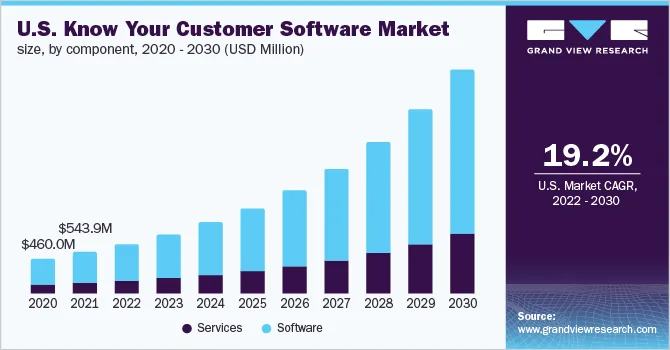
- This growing reliance on analytics-driven KYB is reflected in market investment, with global KYC and KYB spending projected to grow from $30.8B in 2024 to $52.9B by 2029, marking a robust 71% growth trajectory.

- These platforms track transaction records, complaints, fulfillment delays, seller behavior, and other operational signals to enable proactive interventions that prevent fraud and reduce long-term marketplace risk.
Fraud Detection & Transaction Security
- AI and automation also play a significant role in fraud detection and security in the KYB process.
- These technologies help in analyzing onboarding data, transaction frequency, pricing data, and account interactions with others on the platform to detect fraudulent activities.
- Transaction security is maintained by creating risk scores for each seller on the platform and updating them after every new transaction on the marketplace.
- Moreover, you can store lots of data for each seller and leverage it to make better detection models and risk scoring engines to continually protect your business and take data-driven decisions for onboarding new sellers.
Enhancing Marketplace Reputation & User Confidence
- A good KYB verification process ensures your marketplace has the best sellers who are likely to provide awesome services and are less likely to commit fraud or engage in scams on the platform.
- This ultimately enhances your marketplace’s reputation, and users feel confident engaging with your business.
- With better sellers on the platform, you face fewer disputes, and it also increases the operational efficiency of your business, as you are not constantly drowning in disputes and regulatory calls.
Controlled Marketplace Access & Listing Permissions
- Modern KYB platforms provide customized and controlled marketplace access to sellers based on their risk scores and verification status.
- These platforms only allow verified and low-risk customers to post on the platform, and this significantly reduces the risk of synthetic vendors flooding the platform with fake product listings and committing fraud on the platform.