 ChainIT KYB
KYB for Government Agencies: Strengthening Oversight and Reducing Fraud

Jeremy Blackburn
President


Last Updated on 27 February 2026
Quick summary
KYB enhances accountability and transparency in government engagements with contractors and third parties. By verifying the legal status of a business, agencies can identify concealed ownership structures and shell entities used for fraud or money laundering. KYB services strengthen verification controls and security within government agencies.
Introduction
Digital services are expanding rapidly, while fraudulent activity is increasing at a comparable pace. Naturally, this is exposing more procurement, grants, and high-risk contracts. These risks can be mitigated through secure KYB verification.
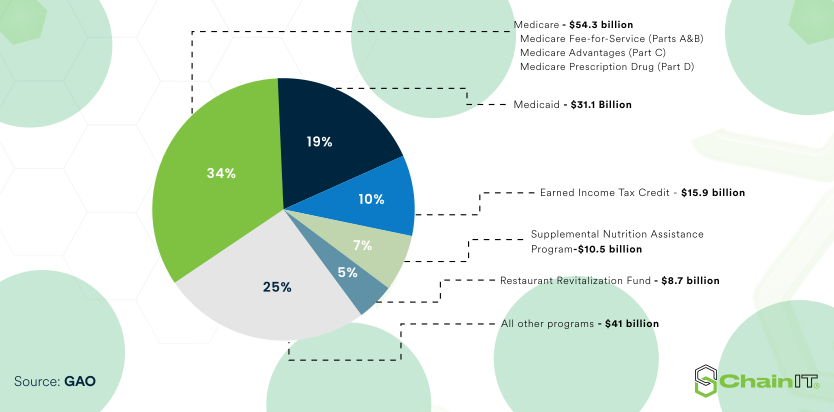
In 2024, the Government Accountability Office in the U.S. indicated the presence of about 162 billion dollars in government-wide improper payments. The last eight years have borne 10.8 billion dollars in DOD fraud. These figures highlight the need for stronger verification and fraud prevention controls.
In the case of government agencies, the application of the KYB process is viewed as an essential protection against scams and other illegal actions. Complete transparency could be improved by KYB in preventing payment crimes, as well as making sure that all regulations are observed and all risks are mitigated.
Systems such as ChainIT have the potential to automate and secure business identity verification, with real-time data checks and audit-ready compliance.
What does KYB mean for Government Agencies Today?
Government agencies require KYB to ensure that public funds and systems are not misused for illegal activities.
- KYB within the government sector assists in authenticating the authenticity and business existence of various third-party organizations, including the service providers, suppliers, grantees, and regulatory authorities.
This shift is not merely a commercial risk mitigation measure; it is essential to ensuring responsible use of public funds and compliance with anti-fraud regulations.
- KYB in the public sector differs from commercial KYB in scope and regulatory focus. Naturally, this will require more stringent rules, like getting registered by government organizations.
- The KYB Business Verification in government stakes includes the money of taxpayers, national security and anti-corruption laws. Conversely, the vested interests of business KYB have fewer political aspects as they deal more with financial fraud.
Government KYB relies primarily on statutory registries and official records, whereas commercial KYB often incorporates financial statements, credit reports, and sanctions data.
Why is KYB Verification of Government Bodies necessary?
Government agencies rely on KYB to enforce compliance with anti-money laundering laws and counter-terrorism financing regulations. When the government agencies interact in different transactions, procurement, or partnerships, KYB will ensure that the public funds are not redirected to fraudulent entities in other organizations that conduct illegal actions.
Digital and AI-driven fraud techniques have made detection significantly more complex. It is at this point where the strength of KYB comes in. To address these challenges, agencies may adopt automated verification platforms such as ChainIT.
The ChainIT system contains automated KYB procedures, which make it possible to examine the situation deeply to keep up with modern-day scams. In addition, the platform simplifies compliance among various businesses.
Let us understand the crucial factors where Government Agencies need KYB Verification.
Increased Fraud, Waste, and Improper Payments in Public Programs
- A survey indicated that 16 agencies had improper payments in 68 programs in 2024, from which around three-fourths of the improper payments were concentrated in sectors such as healthcare and income tax programs.
- Billions of dollars are spent every year due to elaborate fraud schemes, unwarranted services, and omissions in documentation. Stronger identity verification reduces reliance on self-reported data and manual eligibility checks.
Raising Vendor Manipulation and Shell Entities
- A risk of financial crimes is the growth in vendor systems manipulation by means of duplicate registration, obfuscated ownership, and high-risk contracting.
- KYB is essential in addressing vendor manipulation risks in ensuring protection against these activities. Effective KYB extends beyond basic checks and strengthens accountability across vendor ecosystems.
Growing the Digital Interactions between Agencies
- The use of online applications for grants and online procurement portals has greatly enhanced the attack surface of organizations.
- Digital systems expand the attack surface because physical processes have been easily substituted by internet-accessible systems, and therefore, every new portal is a potential point of attack by malicious scammers.
- Combining with third-party vendors is also equivalent to the fact that your organizational system can be attacked. In addition, a malicious link can be aimed at remote users when it is designed properly. KYB helps reduce these risks by verifying entity legitimacy before access is granted.
Legislative and Audit Pressure on Verification
- Global and regional regulatory bodies recognize KYB as a core component of anti-money laundering and counter-terrorism financing frameworks.
- For example, the U.S Financial Crimes Enforcement Network (FinCEN) follows the customer identity rules, which require it to identify and verify owners of legal entities.
- Similarly, the UK has its own AML regulations enforced by the FCA, which require verification of legal entities.
Key Use Cases of KYB Verification for Government Agencies
KYB verification supports government bodies in validating entities, mitigating compliance exposure, and safeguarding public interest. The use cases below illustrate its real-world application.
Public Sector Procurements
KYB in public sector procurement is a significant due diligence process to verify the ownership and risk profile of vendors and contractors before the said agreement. This can help public entities mitigate risks such as fraud and non-compliance with anti-money laundering.
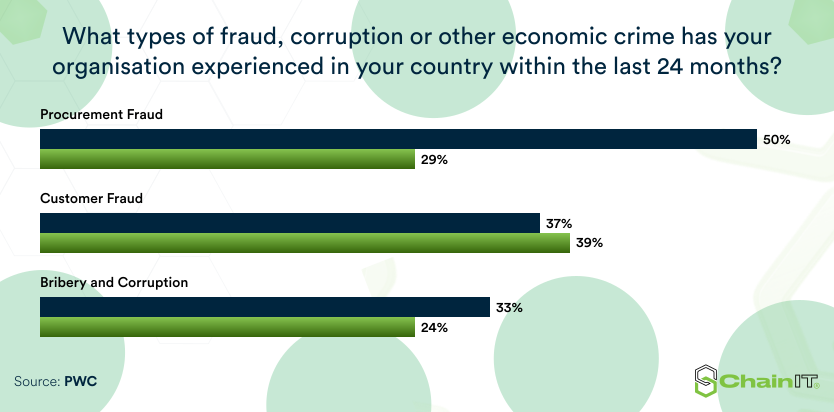
According to a 2024 PwC report, more than 50 percent of respondents globally reported procurement fraud as a widespread concern in their country. Another report projected supply chain fraud losses to exceed 6 billion dollars globally.
Grants and Funding Programs
Substantiation of non-profit companies, academic institutions, and community groups before fund disbursement is a pivotal step as it ensures complete adherence with anti-money laundering and counter-terrorist financing. Ideally, this step helps mitigate risks such as reputational damage, fraud, and other illicit activities.
Law Enforcement and Compliance Authorities
KYB requires businesses to provide official documentation such as business licenses, certificates of incorporation, and tax identification numbers. Needless to say, these details are then cross-referenced against official registries, which confirm a company is legally registered. This authentication is vital for preventing financial crimes such as tax evasion and money laundering.
High-Risk Contracting and Critical Infrastructure Projects
KYB plays a vital part in verifying the identity of subcontractors in critical infrastructure projects.
This works by verifying if the subcontractor is legally registered and an active entity by checking state registers and the official government. Besides verification, the process includes collecting key documents such as operating permits, certificate of incorporation, tax ID numbers, and business address proof.
Cross-Border or International Government Partnerships
For cross-border verification, KYB utilizes technologies such as machine learning and optical character recognition, which extract and verify the data from international documents.
In addition, reputable third-party KYB service providers offer easy access to government databases and international commercial registers for cross verification of foreign entity data. Also, as non-profits have different document requirements, KYB can solve this issue by verifying those documents.
How Government-grade KYB Verification Works: Step-by-Step Process?
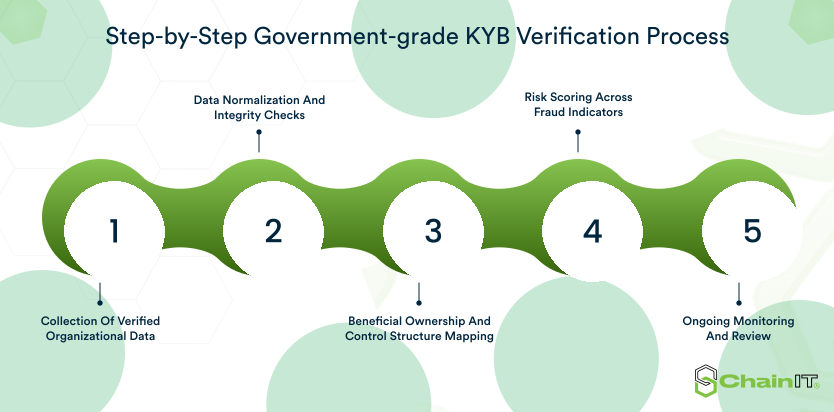
The government-grade KYB verification process gathers and validates extensive data about a business from authoritative sources. Let’s delve into how it works:
Step 1: Collection of Verified Organizational Data
- Government-grade verification draws data from multiple authoritative sources. This includes official government registries, where they source data from reliable sources such as national business registries or tax authorities.
- Apart from this, they collect data from official documents, tax registers, and third-party data providers.
- Third-party data providers integrate with reliable data sources via API to provide real-time verification when needed.
Step 2: Data Normalization and Integrity Checks
- You can expect the data normalization process to standardize data formats and reduce redundancy, producing structured data that is ready for advanced analytics.
- Platforms like ChainIT can standardize data pipelines, entity solutions, and cross-data set correlation. Cross-validation is vital to remove biases in data.
Step 3: Beneficial Ownership and Control Structure Mapping
- KYB verification in anti-fraud units and audits mainly depends on beneficial ownership and control, which is essential to unmask people who own a legal entity
- Also, this process prevents the use of shell companies and other corporate networks to launder money.
- After information collection, a mapping of the ownership structure is followed by verification, risk profiling, and ongoing monitoring.
- BOC mapping maintains data integrity and facilitates accountability.
Step 4: Risk Scoring Across Fraud Indicators
- Risk scoring in KYB works on a systematic approach to identify and mitigate potential financial crimes in business entities.
- Also, it uses a risk-based approach, which is guided by global standards to assign a dynamic risk score that further determines the level of due diligence.
Step 5: Ongoing Monitoring and Review
- Ongoing monitoring and review in KYB is a mandatory process that manages risks and detects fraud, ensuring compliance with anti-money laundering.
- Modern KYB platforms utilize AI tools to provide real-time updates, sanctions updates or changes in tax exposure.
- Regular internal audits ensure ongoing effectiveness.
Barriers to Implementing KYB in Government Bodies
By now, you may have understood the benefits and importance of KYB verification in government operations. However, to ensure robust and reliable security, it is equally important to understand the primary barriers to implementing KYB within government bodies. Key barriers include:
Fragmented Data Across Departments: Government agencies rely on multiple systems that do not communicate effectively, making it difficult to obtain a consistent single view of business information.
Manual Verification Burden: Many government agencies rely on a manual verification process, which is prone to human errors. Integrating modern KYB solutions in these frameworks can be costly.
Missing Visibility into Cross-Border Entities: KYB for cross-border entities can face inconsistency due to international regulations, complex ownership structures, and fragmented data sources.
Legacy Systems and Interoperability Challenges: If the legacy systems use outdated technology or have a high maintenance cost, they can be barriers to implementing KYB.
Also, business data within government bodies is often stored in fragmented and disconnected systems, which create data silos and also prevent seamless data sharing.
Platforms such as ChainIT can integrate with legacy systems through APIs to extend existing system capabilities and bridge them into modern and blockchain-backed services within the KYB and identity verification system. This allows for real-time data flow from internal systems to ChainIT verification systems, reducing fraud risks and ensuring compliance.
Conclusion
Once you start using KYB to strengthen procurement law enforcement, grants, and risk contracting, the operational and compliance benefits become clear. The process ensures transparency and legitimacy of business entities, thus preventing fraud, money laundering, and illicit activities. Lastly, the process promotes value for money and integrity.
KYB verification has become the most vital aspect for customer confidence and scalability. Government agencies that prioritize compliance and security over traditional processing will remain future-ready.
Frequently Asked Questions
KYB for government agencies supports national security objectives in procurement, grants, and public accountability. On the other hand, commercial KYB focuses more on financial sector compliance with global AML rules.
Public bodies need organizational verification to ensure accountability, risk mitigation, and transparency in the use of public funds. This process prevents corruption at all levels.
KYB reduces fraud by verifying the legitimacy of the applicant entity. With this, it becomes difficult for fraudsters to use fake identities and shell companies to steal public funds.
By generating structured data and investigative insights that protect against financial crimes such as terrorist funding and money laundering. Regulatory entities need to cooperate with law enforcement.
ChainIT leverages advanced technologies like Blockchain, Automation and AI to provide a secure, auditable process that can replace manual methods.
- KYB verification for government bodies uses primary data sources like public records, government registers, and authoritative government databases.
- Key sources also include the tax registry database and regulatory body registers.
The main challenges in implementation are regulatory complexity and data fragmentation. Reliance on manual processes is also one challenge.
Yes, ChainIT supports continuous monitoring of high-risk vendors and grantees through a risk management framework with products that include a business rules engine and immutable audit trail approach.


Related Resources

 ChainIT KYB
 Critical KYB Compliance Risks Businesses Often Overlook
KYB has become a critical safeguard as fraud grows more sophisticated and regulatory requirements become stricter. These overlooked risks expose firms to fraud, regulatory penalties,…
By Tim Hines
23 Feb, 2026

 ChainIT KYB
 KYC vs KYB vs AML: Practical Differences That Impact Business Risk
KYC verifies individuals, KYB verifies businesses, and AML monitors and prevents financial crime across platforms. All three are essential for building a secure and compliant…
By Jeremy Blackburn
20 Feb, 2026
 ChainIT KYB
 What Is KYB Verification? A Practical Guide for Compliance, Risk Controls, and Business Onboarding
KYB verification confirms the legal existence of a business, validates its ownership structure, and assesses associated risk levels. An organization can ensure regulatory compliance and…
By Tim Hines
17 Feb, 2026


Modernizing Digital Identity
Join Us Today!
Join ChainIT today and experience a future where nothing is assumed—everything is verified. Our blockchain-powered platform ensures the authenticity of products, services, and events, protecting you from fraud and securing what matters most.
Take the next step toward a more transparent, secure, and connected world.
Request Demo